

In the high-stakes world of mission-critical infrastructure, safety is not a matter of compliance; it is a strategic imperative. For project managers, lead designers, and commercial clients overseeing complex industrial builds, the role of the CDM Principal Designer is pivotal. This position transcends administrative box-ticking, demanding a level of technical leadership and strategic foresight that directly influences project success, operational integrity, and long-term asset safety. Master the statutory duties and strategic value of the CDM Principal Designer role within complex, high-risk infrastructure environments.
Generalist safety advice is insufficient when dealing with the intricate hazards of data centres, high-voltage environments, or automated industrial facilities. The Construction (Design and Management) Regulations 2015 (CDM 2015) mandate a clear line of responsibility, and for sophisticated projects, this requires a specialist partner who can architect safety into the very DNA of the design. This guide explores the duties, challenges, and strategic importance of the CDM Principal Designer, moving beyond legislative text to provide a framework for excellence in high-risk project delivery.
Defining the CDM Principal Designer Under CDM 2015
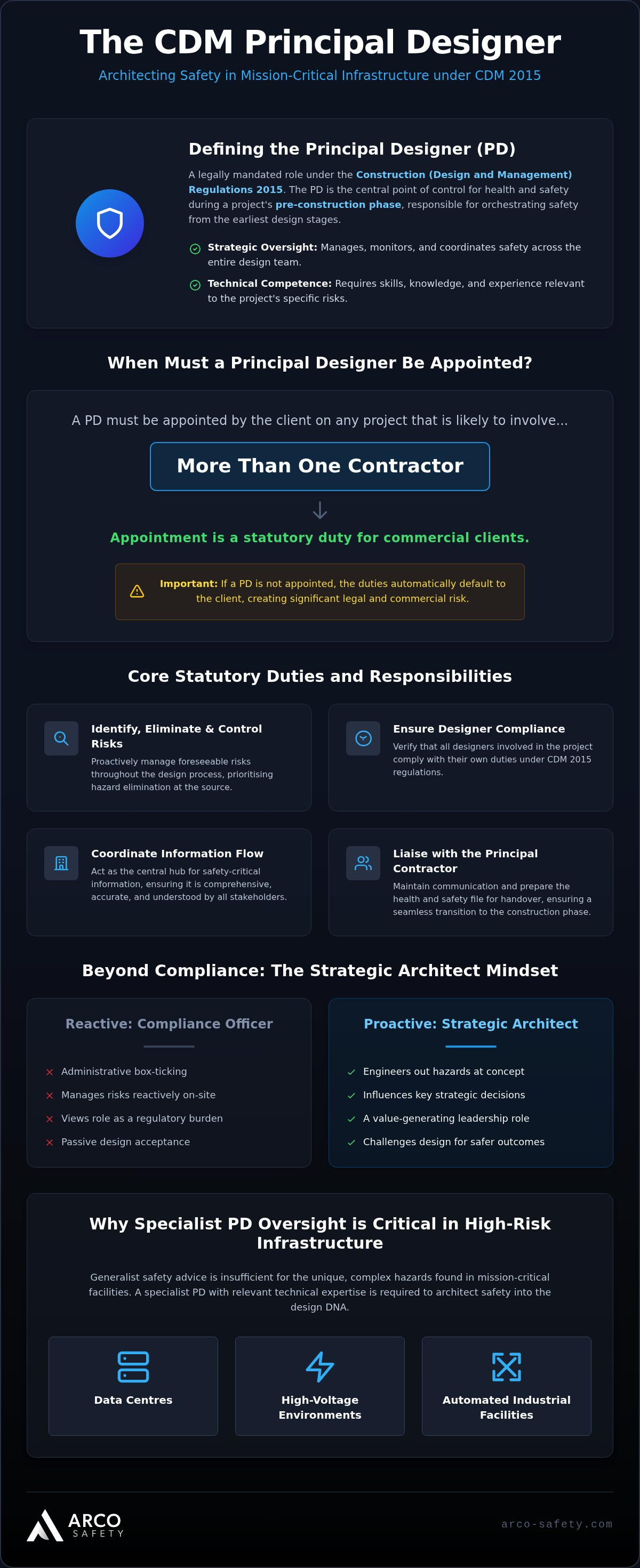
The CDM Principal Designer is a legally mandated role under the Construction (Design and Management) Regulations 2015. It is far more than a supplementary administrative function; it is the central point of control for health and safety during the pre-construction phase of a project. This duty holder is responsible for orchestrating safety considerations from the earliest stages of design, ensuring that risks are eliminated or controlled at source rather than managed reactively on-site.
- The Principal Designer (PD) is a statutory role appointed by the client on any project involving more than one contractor. This can be an organisation or an individual with the requisite skills, knowledge, experience, and organisational capability.
- Their fundamental responsibility is to plan, manage, monitor, and coordinate health and safety throughout the pre-construction (design) phase. This involves integrating safety into every decision, from concept to construction readiness.
- Appointment requires demonstrable technical competence, professional skills, and organisational capability relevant to the specific nature of the project. For high-risk industrial works, this implies specialist knowledge beyond general construction.
- There is a critical distinction between a ‘designer’ and the Principal Designer. Whilst all designers have duties under CDM, the PD has strategic oversight, coordinating the efforts of the entire design team to ensure a cohesive and robust approach to safety.
When Must a Principal Designer Be Appointed?
The appointment of a CDM Principal Designer is not optional on most commercial projects. The legal triggers are clear and designed to ensure that safety leadership is established early in the project lifecycle. Failure to appoint a PD where required results in the duties automatically defaulting to the client, creating significant legal and commercial risk.
- Legal Triggers: A Principal Designer must be appointed on any project that will involve, or is likely to involve, more than one contractor working on the project at any time. Given the complexity of modern infrastructure projects, this applies to the vast majority of commercial and industrial builds.
- Client Distinction: The regulations differentiate between 'commercial' and 'domestic' clients. For commercial clients, the duty to appoint a PD (and a Principal Contractor) is absolute. For domestic clients, these duties can pass to other parties if not explicitly appointed.
- Criticality of Early Appointment: In high-risk infrastructure, appointing the Principal Designer at the project's inception is paramount. Early involvement allows the PD to influence strategic decisions, eliminate significant hazards at the concept stage, and prevent costly and dangerous redesigns later in the programme.
The PD as a Strategic Safety Architect
The most effective CDM Principal Designers operate not as compliance officers, but as strategic architects of safety. This mindset transforms the role from a regulatory burden into a value-generating function that protects the project's integrity, budget, and timeline. It is an active, leadership-driven role focused on proactive risk management.
- Moving Beyond Passive Design: A strategic PD actively challenges design assumptions and promotes the use of safer materials, construction methods, and maintenance strategies. Their goal is to engineer out hazards before they ever become a risk on site.
- Coordinating Information Flow: In complex projects with multiple design disciplines (structural, mechanical, electrical), the PD acts as the central hub for safety-critical information. They ensure that the flow of pre-construction information is comprehensive, accurate, and understood by all stakeholders.
- Embedding Safety in the Design DNA: The ultimate objective is to ensure that safety is not an add-on but a fundamental pillar of the project's design. This means every key decision is scrutinised through the lens of health and safety, from initial site layout to the specification of components for long-term maintenance.
Statutory Duties and Regulatory Responsibilities
The duties of the CDM Principal Designer are explicitly defined by the Health and Safety Executive (HSE) and enshrined in the CDM 2015 regulations. These responsibilities form the legal bedrock of the role and are focused on proactive management during the pre-construction phase. A failure to discharge these duties can lead to regulatory action, project delays, and significant legal liability for the client and the appointed PD.
- Identifying, Eliminating, or Controlling Foreseeable Risks: The core function is to ensure that risks are managed throughout the design process. The PD must take all reasonable steps to eliminate hazards. Where elimination is not possible, they must control and mitigate risks, ensuring clear information is passed to the construction team.
- Ensuring Designer Compliance: The Principal Designer is responsible for making sure that all other designers involved in the project comply with their own duties under CDM 2015, such as applying the Principles of Prevention and cooperating with other team members.
- Collaborating with the Principal Contractor: The PD must liaise with the Principal Contractor (PC), sharing all relevant safety information and assisting them in the planning, management, and monitoring of the construction phase. This includes providing any information needed for the development of the Construction Phase Plan.
- Preparing the Health and Safety File: The PD is responsible for preparing a Health and Safety File, a critical document containing relevant safety information needed to manage the asset safely throughout its entire lifecycle, including future maintenance, cleaning, and eventual decommissioning.
Coordinating the Pre-Construction Phase
Effective coordination is the hallmark of a high-performing Principal Designer. This involves managing the complex interplay of information and stakeholders to create a unified and safety-focused design process. The PD acts as the conductor of the pre-construction orchestra, ensuring all parts work in harmony.
- Managing Information Exchange: The PD must establish and manage clear channels for communication and information exchange between the client, the design team, and the Principal Contractor. This prevents critical safety details from being lost in silos.
- Overseeing Pre-Construction Information (PCI): The PD assists the client in pulling together the Pre-Construction Information package. They must assess its adequacy and ensure it contains all the necessary data for designers and contractors to work safely, identifying and addressing any gaps.
- Identifying Gaps in Site Data: A key task is to scrutinise the available site information for omissions. This could involve identifying the need for new utility surveys, asbestos reports, ground condition assessments, or structural reports before design work can proceed safely.
Risk Management and the Hierarchy of Control
The Principal Designer's approach to risk management must be systematic and rooted in established safety principles. The primary goal is always elimination, a strategy that provides the highest level of protection and is often the most cost-effective solution when implemented early.
- Applying the Principles of Prevention: The PD must ensure that the design team applies the general Principles of Prevention. This hierarchy of control prioritises eliminating hazards, and only then moves to options like substituting with less hazardous materials, providing collective protection (e.g., edge protection), and finally, relying on personal protective equipment (PPE).
- Documenting Design Decisions: Critical design decisions made to mitigate risks must be formally documented. This creates a clear audit trail demonstrating how safety was considered and provides vital information for the Health and Safety File, benefiting future owners and maintenance teams.
- Within industrial engineering, a foreseeable risk is a hazard that a competent professional could reasonably anticipate during the design, construction,operation, or decommissioning of a specialised asset, considering its intended use and technical complexity.
Strategic Safety in High-Risk and Mission-Critical Infrastructure
The role of the CDM Principal Designer becomes exponentially more critical in high-risk and mission-critical environments. Standard construction safety knowledge is inadequate for navigating the unique hazards present in data centres, industrial manufacturing plants, or high-voltage electrical facilities. In these sectors, the PD must be a technical specialist, not a generalist.
- Data Centre Construction Cycles: These projects involve a unique convergence of risks, including high-density power distribution, complex cooling systems, fire suppression technologies, and the absolute necessity of avoiding downtime. The PD must understand the entire build cycle and its specific safety implications.
- High-Voltage Electrical Safety: Designing industrial substations or integrating large-scale power systems requires profound expertise in electrical safety. The PD must ensure the design protects not only the construction teams but also the engineers who will operate and maintain the systems for decades to come.
- Automotive and Manufacturing Workstreams: The integration of automated machinery, robotics, and complex logistics systems introduces significant hazards. The PD must coordinate safety between the building design and the process engineering, ensuring seamless and safe integration.
- The Failure of Generalist Advice: Generalist H&S consultants often lack the granular, sector-specific knowledge to identify or control complex engineering hazards. Their advice can be superficial, leading to designs that are compliant on paper but impractical or unsafe in reality. Elite projects demand elite, specialist oversight.
Data Centre Safety: Technical Oversight
Data centres are the nerve centres of the digital economy, and their construction demands uncompromising precision. The Principal Designer must provide technical oversight that goes far beyond standard CDM duties, addressing the unique operational and safety challenges of these facilities.
- Addressing Systemic Risks in Design: The PD must ensure the design phase adequately addresses risks associated with industrial-scale cooling systems (e.g., chemical or pressure hazards), uninterruptible power supplies (UPS), backup generators, and the management of extreme electrical loads in high-density rack environments.
- Coordinating for Mission-Critical Uptime: In live environments or phased builds, the PD’s role is crucial in designing safe methods of work that prevent any disruption to ongoing operations. This requires meticulous planning where downtime is not an option.
- Managing Rapid Construction Timelines: The data centre market moves at high speed. The Principal Designer must implement robust processes that ensure CDM compliance and safety rigour are maintained without impeding aggressive construction programmes.
Industrial Electrical Safety and PUWER Integration
In industrial settings, the responsibilities of the CDM Principal Designer often intersect with other critical regulations, such as the Provision and Use of Work Equipment Regulations (PUWER). A specialist PD provides strategic oversight to ensure these legal frameworks are aligned, not treated in isolation.
- Aligning CDM and PUWER Duties: When designing facilities that will house heavy machinery, the PD must ensure the design accommodates the safe installation, operation, and maintenance of that equipment. This includes considerations for foundations, power supply, safe access, and emergency systems.
- Strategic Oversight of High-Voltage Environments: The PD must ensure the design of high-voltage (HV) areas prioritises the safety of future maintenance teams. This involves designing in features like clear isolation points, safe clearances, appropriate signage, and robust arc flash mitigation measures.
- Ensuring a Comprehensive Health and Safety File: For these environments, the Health and Safety File is a critical operational document. The PD must ensure it includes detailed technical electrical schematics, safe isolation procedures, equipment specifications, and maintenance requirements to protect the asset's future workforce.
Orchestrating the Transition: Pre-Construction to Delivery
One of the most critical functions of the CDM Principal Designer is to manage the seamless and safe transition from the pre-construction phase to on-site delivery. This handover is not a single event but a managed process that requires a robust framework, clear communication, and ongoing collaboration. A Principal Designer with a deep, practical understanding of the construction phase is essential for bridging the gap between design theory and site reality.
- Developing a Robust Handover Framework: The PD is responsible for developing a structured process for transferring safety-critical design information to the Principal Contractor. This ensures that the risk assessments and mitigation strategies developed during design are fully understood and implemented.
- Validating the Construction Phase Plan (CPP): The PD must review the Principal Contractor's initial Construction Phase Plan to ensure it adequately addresses the risks identified in the Pre-Construction Information and that the proposed H&S arrangements are suitably robust for the project's complexity.
- Ongoing Liaison for Design Changes: Design rarely remains static once construction begins. The PD must maintain an ongoing liaison with the project team to review and manage the safety implications of any significant design changes or variations.
- The Health and Safety File as a 'Living Document': The PD must champion the Health and Safety File from day one, ensuring it is developed progressively throughout the project rather than being hastily assembled as a post-completion afterthought. This ensures it is a valuable and accurate asset management tool.
Five Steps to a Seamless Safety Handover
A structured handover process is vital for maintaining the integrity of the safety strategy. Following a clear, multi-step approach ensures that no critical information is lost and that the Principal Contractor is fully equipped to manage the on-site risks.
- Step 1: Finalising the Pre-Construction Information Package: Before handover, the PD confirms that the PCI is complete, accurate, and reflects the final pre-construction design. Any outstanding queries or information gaps are resolved.
- Step 2: Briefing the Principal Contractor on Residual Risks: The PD conducts a formal briefing with the PC's team to walk through the significant residual risks identified during the design phase—those that could not be eliminated and must be managed on site.
- Step 3: Reviewing Proposed H&S Arrangements: The PD assesses the adequacy of the PC’s proposed arrangements for managing the construction phase, including their risk assessments, method statements (RAMS), traffic management plans, and emergency procedures.
- Step 4: Establishing Clear Communication Channels: Formal protocols are established for managing design queries, reporting hazards, and communicating changes. This ensures a clear and auditable line of communication between the design and construction teams.
- Step 5: Agreeing the Process for Updating the Health and Safety File: The PD and PC agree on a clear process for gathering and inputting information into the Health and Safety File as the project progresses, ensuring it is kept up-to-date.
Maintaining Design Integrity During Construction
The Principal Designer's involvement does not cease the moment construction begins. They retain a crucial role in safeguarding the original safety intent of the design, especially when unforeseen challenges or changes arise on site.
- Managing the 'Temporary Works' Trap: Temporary works are a common area where design safety can be compromised. The PD must ensure that the design and implementation of temporary structures (e.g., propping, falsework) are properly coordinated and do not introduce new, unmanaged hazards.
- Remaining Involved in Significant Design Changes: Should a significant design change be required post-commencement, the PD must be involved to assess its health and safety implications. This prevents well-intentioned site modifications from inadvertently undermining the core safety strategy.
- During construction, the Principal Designer's role transitions to that of a strategic advisor, maintaining design integrity by collaborating closely with the lead designer and Principal Contractor to manage variations and resolve emerging technical safety challenges.
Technical Leadership: Why Elite Projects Require Specialist PD Oversight
For high-stakes infrastructure projects, selecting a CDM Principal Designer is not a procurement exercise; it is a strategic appointment. The difference between a service focused on basic compliance and one delivering genuine technical leadership can define a project's success. A specialist PD provides precision-engineered CDM coordination, transforming a regulatory necessity into a competitive advantage.
- Arco Safety’s Approach: We provide strategic CDM leadership for high-stakes environments. Our methodology is built on a holistic understanding of the entire project lifecycle, from design inception (PD) to site execution (as a Principal Contractor), ensuring safety is practical, not just theoretical.
- Compliance vs. Strategic Leadership: A compliance check confirms that minimum standards have been met. Strategic safety leadership actively seeks to exceed them, identifying opportunities to enhance safety, improve efficiency, and reduce long-term operational risk.
- Reducing Project Delays and Costs: Embedded expert consultancy identifies and resolves safety challenges early in the design phase, preventing the costly delays, rework, and unforeseen costs that arise when issues are only discovered on site.
- Focus on Operational Excellence: Our focus is on the management of intricate workstreams and the seamless integration of safety into complex operational requirements. We ensure the final asset is not only safe to build but also safe and efficient to operate and maintain.
The Value of a Specialist Partner
Choosing a specialist CDM partner like Arco Safety de-risks your project and elevates your approach to health and safety. It is an investment in certainty, rigour, and operational integrity, delivering value far beyond the cost of the service.
- Leveraging Deep Sector Expertise: Our consultants possess deep, proven expertise in high-risk sectors, including Working at Height, Electrical Safety, data centres, and industrial manufacturing. We speak the language of your engineers and understand your unique challenges.
- Reducing Client Liability: We reduce your liability under CDM 2015 through uncompromising technical rigour. Our robust processes and meticulous documentation provide a clear audit trail demonstrating that you have discharged your duties to the highest standard.
- Positioning Safety as a Pillar of Success: We work with clients who view safety as a fundamental pillar of project excellence. Our role is to act as your strategic partner, embedding this principle into every stage of your project.
Securing Your Next Infrastructure Project
Ensure your next mission-critical project is founded on an uncompromising commitment to safety and technical excellence. Integrating a specialist CDM Principal Designer from the outset is the first step towards a successful, safe, and compliant outcome.
- Integrate Arco Safety as Your CDM Principal Designer: Partner with us from the concept stage to embed strategic safety leadership into the core of your project.
- Lead with Masters of Complex Environments: Ensure your project team is guided by genuine specialists who thrive in technically demanding environments where generalist advice is not enough.
- Discover how Arco Safety provides strategic CDM leadership for your high-risk project
Frequently Asked Questions
Can the Client also be the CDM Principal Designer?
Yes, a client can act as their own Principal Designer, but only if they possess the necessary skills, knowledge, experience, and organisational capability to fulfil all the statutory duties for a project of that specific size, nature, and complexity. For high-risk industrial projects, it is rare for a client organisation to have this specialist in-house capability, making external appointment the standard and recommended practice.
What happens if a Principal Designer is not appointed?
If a client fails to appoint a Principal Designer on a project where one is required (i.e., any project with more than one contractor), the client themselves is held legally responsible for fulfilling all the PD's duties under CDM 2015. This places a significant legal burden and liability directly onto the client.
How does the Building Safety Act 2022 affect the PD role?
The Building Safety Act 2022 introduces a new duty holder role of 'Principal Designer' for building regulations compliance on higher-risk buildings (HRBs). This is a separate role from the CDM Principal Designer, though the same person or organisation can hold both roles if they are competent to do so. For projects in England involving HRBs, there will be a need to coordinate the duties of the CDM PD (health and safety) and the BSA PD (building regulations), making integrated, competent leadership even more critical.
Is a Principal Designer required for all construction projects?
A Principal Designer is required for any project with more than one contractor. This includes most projects, from small refurbishments to major infrastructure builds. For projects with only a single contractor, there is no requirement to appoint a PD, but the contractor and designer(s) still have their own duties under CDM 2015.
What is the difference between a Designer and a Principal Designer?
A 'Designer' is any organisation or individual who prepares or modifies a design for a construction project. They have a duty to eliminate or control foreseeable risks arising from their design. The 'Principal Designer' is a leadership role with a broader, strategic responsibility to plan, manage, monitor, and coordinate the health and safety of the entire pre-construction phase, including the work of all other designers.
Does the Principal Designer need to be on-site during construction?
The Principal Designer's primary duties are focused on the pre-construction (design) phase. There is no general legal requirement for them to be on-site full-time during construction. However, they must maintain an ongoing liaison to deal with design changes and queries, which may necessitate site visits to resolve issues and ensure design integrity is maintained.
How much does a specialist CDM Principal Designer service cost?
The cost of a specialist CDM Principal Designer service varies depending on the project's size, duration, complexity, and risk profile. It is typically priced as a professional consultancy fee. Whilst it represents an additional project cost, it should be viewed as a critical investment in risk reduction, compliance, and long-term asset safety, often preventing far greater costs associated with accidents, enforcement action, and design-related delays.
What information should be included in the Health and Safety File?
The Health and Safety File is a record of information for the end-user, focusing on health and safety. It should include information needed for safe future use, cleaning, maintenance, and demolition. Key contents include: 'as-built' drawings, details of key structural principles, information on hazardous materials used (e.g., asbestos), specifications of installed plant and equipment, and safe access and maintenance procedures.

