

In high-stakes infrastructure, a compliance error is rarely just a legal oversight; it's a systemic threat to operational continuity and personnel safety. For mission-critical assets like data centres or industrial plants, the standard tick-box approach to safety is insufficient. You understand that generalist consultants often lack the technical depth required to manage complex electrical workstreams or high-risk pre-construction phases. This gap in expertise creates unnecessary friction, leading to project delays and increased regulatory scrutiny. By engaging a specialist CDM management consultancy, you bridge the divide between abstract regulation and technical execution.
This article outlines how to master the complexities of CDM 2015 through strategic oversight and engineering precision. We'll examine the transition from planning to delivery, focusing on how expert Principal Designer oversight reduces liability and embeds safety into the earliest design stages. You'll gain a clear roadmap for achieving operational excellence in the UK's most demanding environments without compromising on project velocity. We'll move from broad strategic concepts down to the specific areas of technical mastery required to protect your assets and your reputation.
Key Takeaways
- Learn why traditional safety approaches fall short in high-voltage environments and how to implement a more robust framework for mission-critical infrastructure.
- Discover the strategic value of a specialist CDM management consultancy in navigating the unique regulatory and technical challenges of data centre construction.
- Understand the pivotal role of the Principal Designer in bridging the gap between complex engineering designs and practical on-site safety execution.
- Gain insights into developing technically precise Pre-Construction Information that reduces liability and prevents costly project delays.
- Shift from basic compliance to operational excellence by integrating safety as a fundamental pillar of your project’s strategic architecture.
The Evolution of CDM 2015 in High-Risk Infrastructure
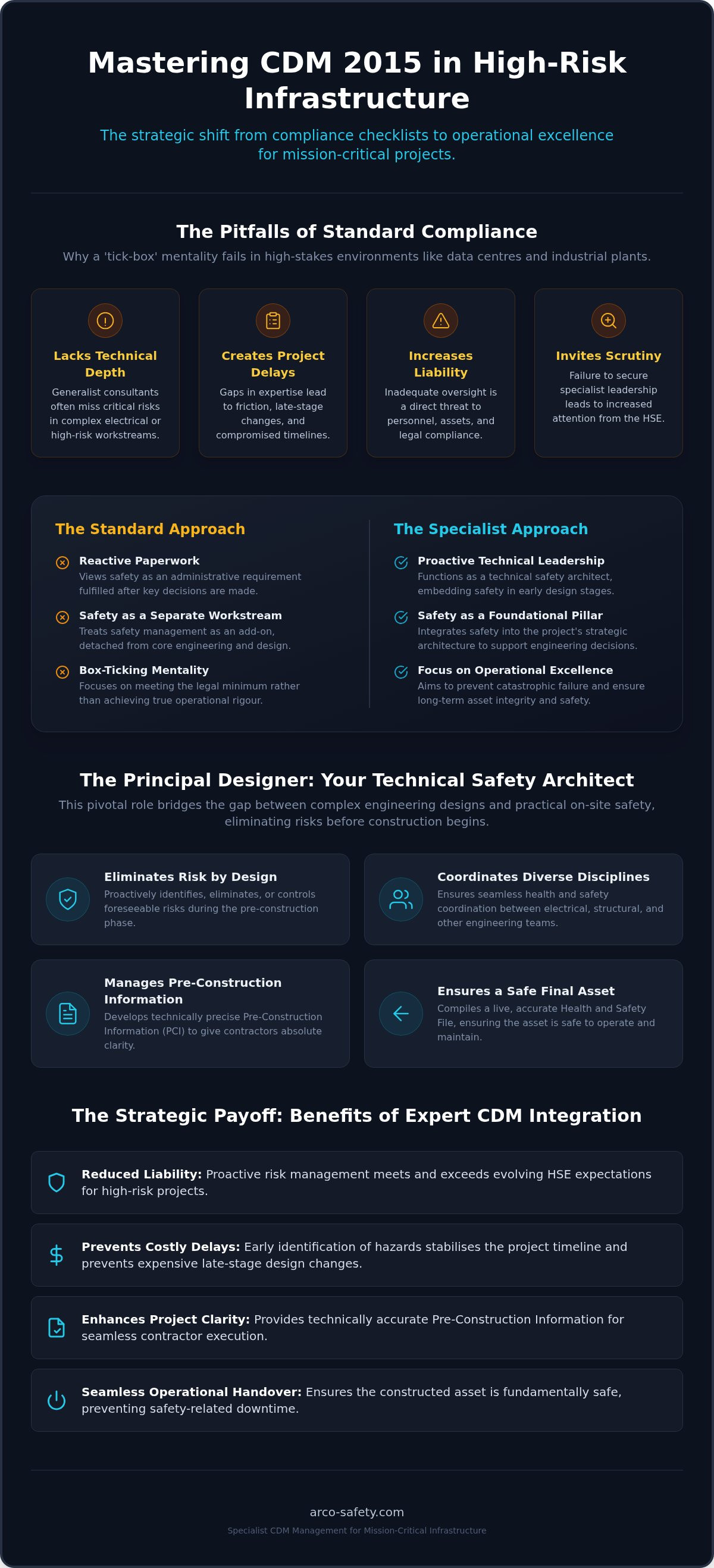
Construction Design and Management (CDM) 2015 regulations are often viewed as a administrative requirement for general building works. However, in the context of mission-critical infrastructure, this perspective is dangerously reductive. A specialist CDM management consultancy operates as a technical safety architect, ensuring that the regulatory framework aligns with the high-stakes reality of industrial and data centre environments. Standard approaches often fail because they lack the technical depth to manage the intersection of live high-voltage systems and complex construction workstreams.
The transition from reactive safety paperwork to proactive technical leadership is essential for protecting the long-term operational integrity of an asset. In high-risk zones, safety cannot be a separate workstream; it must be the foundation upon which engineering decisions are made. This shift ensures that the project doesn't just meet a legal minimum but achieves a level of operational rigour that prevents catastrophic failure. It's about building a framework of security that supports, rather than hinders, the delivery of sophisticated engineering projects.
Beyond Compliance: CDM as a Strategic Asset
Moving beyond a "box-ticking" mentality requires integrating safety directly into the engineering design phase. This proactive approach significantly impacts project ROI by preventing the costly delays associated with poorly planned pre-construction phases. When a specialist consultancy identifies hidden risks early, such as overlapping high-risk workstreams or restricted access in energized zones, the project timeline remains stable. Key benefits of this strategic integration include:
- Reduction in late-stage design changes that compromise safety or functionality.
- Enhanced clarity for contractors through technically accurate Pre-Construction Information (PCI).
- Seamless transition from construction to operational phases without safety-related downtime.
The Legal Landscape for High-Stakes Projects
HSE expectations for high-risk infrastructure continue to evolve, with a clear focus on the competency of those managing technical risks. Liability for clients and directors under CDM 2015 remains substantial; the law requires that those in control of projects ensure safety is managed at every stage. In technical environments, inadequate oversight isn't merely a compliance gap. It's a direct threat to personnel and the physical asset. Professional oversight ensures that duty holders meet their legal obligations whilst maintaining the pace of delivery required in competitive sectors like data centre construction. Failure to secure specialized leadership often leads to increased regulatory scrutiny and potential project suspension.
The Strategic Role of a CDM Management Consultancy
In complex industrial builds, the role of a CDM management consultancy extends far beyond ensuring compliance; it provides the technical gravity required to anchor a project's safety framework. A strategic consultant acts as a bridge between the Client and multiple specialist design teams. They ensure that information flows methodically amongst stakeholders, preventing the silos that often lead to critical safety oversights. This level of oversight is particularly vital in environments where high-voltage systems and mission-critical data infrastructure are being integrated simultaneously. Without this central technical authority, the risk of conflicting design specifications increases, potentially compromising both safety and operational continuity.
Principal Designer Duties in Complex Environments
The Principal Designer is the technical safety architect of the project. Their primary duty is to eliminate or control risks during the design phase, long before a spade hits the ground. In high-risk sectors, this involves coordinating health and safety amongst diverse engineering disciplines, from structural specialists to electrical systems designers. A robust approach ensures that the Health and Safety File isn't a static archive but a live, technically accurate document that reflects the evolving reality of the build. By maintaining this rigour, the Principal Designer ensures that the final asset is safe to operate and maintain throughout its lifecycle. This process requires more than just administrative skill; it demands the technical competence to challenge design assumptions and enforce safety-by-design principles.
Client Advisory and Strategic Leadership
Clients bear the ultimate responsibility for CDM compliance, yet they often lack the internal technical resources to manage these duties effectively. A specialist advisor assists the Client in discharging these legal obligations without disrupting the pace of operations. This includes evaluating the competence of other dutyholders, a task that requires deep industry knowledge in technical sectors. Establishing a culture of safety that commands respect across the entire workstream is a hallmark of elite leadership. It transforms safety from a constraint into a pillar of operational excellence. For organisations seeking this level of technical precision, specialist CDM management provides the necessary strategic oversight to manage complex risks effectively. This leadership ensures that every contractor and designer understands their role within the broader safety architecture, reducing the likelihood of project friction and regulatory intervention.
Technical Oversight vs. Standard Compliance
Standard safety advice often fails in environments where a single error can trigger national grid disruption or catastrophic data loss. Generalist consultants typically lack the engineering literacy required to interpret complex schematics, which leads to generic risk assessments that don't address the specific hazards of high-density power distribution. A specialised CDM management consultancy bridges this gap by applying technical rigour to every phase of the project lifecycle. Whilst a generalist might focus on perimeter fencing and basic site access, a specialist understands the nuanced risks associated with energised systems and mission-critical infrastructure. This technical depth is the difference between a project that merely meets legal minimums and one that is engineered for operational resilience.
Maintaining "Business as Usual" (BAU) whilst managing construction safety in live environments is perhaps the greatest challenge in high-risk sectors. The precision-led approach of Arco Safety Ltd contrasts sharply with standard practices by embedding technical oversight into the fabric of the build. We don't just monitor compliance; we manage the transition from construction to operation with a focus on stability. This level of detail ensures that construction activities never compromise the integrity of existing live systems, a requirement that generalist firms often overlook in their pursuit of basic regulatory alignment. Our methodology prioritises the continuity of your core operations above all else.
Specialised Safety in Data Centre Builds
In data centre construction, the pace is relentless and the technical requirements are unforgiving. Rapid-deploy modular construction requires an oversight model that differs significantly from traditional brick-and-mortar builds. We manage the intersection of mechanical, electrical, and plumbing (MEP) risks, ensuring that cooling systems and high-density power environments are integrated without compromising safety. Our strategic oversight extends to the management of CRAC units and complex chiller networks, where pressurised systems and chemical handling require specific technical competence. This ensures that the speed of the build never outpaces the security of the design, protecting your investment from avoidable failure.
Electrical Safety and Technical Compliance
Integrating CDM duties with high-voltage safety management is a specialist discipline that demands absolute authority. It involves ensuring technical precision during the installation of switchgear and the construction of on-site substations. The consultant's role is particularly critical during electrical testing and commissioning; this is the phase where construction safety transitions into operational reliability. As a leading CDM management consultancy, we provide the oversight necessary to manage these high-stakes workstreams, ensuring that every test protocol is followed and every safety interlock is verified. This methodical approach protects both the personnel on-site and the long-term viability of the electrical infrastructure, facilitating a seamless handover to your operations team.
Implementing CDM Management Throughout the Project Lifecycle
Lifecycle management in high-stakes infrastructure requires a methodical, step-by-step framework that aligns with the RIBA Plan of Work. A specialist CDM management consultancy provides the technical oversight required to ensure safety is woven into every engineering milestone. This process isn't a series of isolated checks but a continuous thread of rigour that prevents the erosion of safety standards as the project moves from design to delivery. Effective implementation ensures that the safety strategy evolves alongside the project's technical complexity.
The Pre-Construction Phase: Setting the Standard
Gathering Pre-Construction Information (PCI) is often treated as a clerical task by generalist firms. For mission-critical builds, this phase requires the collation of technically accurate data regarding existing live services, structural load limits, and environmental constraints. Facilitating design risk workshops allows the team to identify and resolve complex engineering challenges before they manifest on-site. Key actions during this phase include:
- Interrogating existing site data to produce a technically robust PCI that contractors can rely on.
- Leading design workshops to mitigate risks in complex mechanical and electrical designs.
- Establishing clear safety KPIs that align with the client’s long-term operational requirements.
Construction Phase Oversight and Rigour
Rigour during the construction phase is defined by the quality of the Construction Phase Plan (CPP) review. We don't simply verify that a plan exists; we interrogate its technical feasibility against the specific risks of industrial workstreams. Ongoing site inspections must prioritise high-risk activities, such as working at height on modular frames or managing heavy lifting in congested zones. This level of scrutiny ensures a seamless transition between construction and the eventual operational phase, protecting the integrity of the build throughout.
- Verifying the technical accuracy of the Principal Contractor’s CPP against real-world site conditions.
- Conducting inspections on high-risk industrial workstreams, including high-voltage testing.
- Monitoring the methodical flow of health and safety information amongst diverse subcontractors.
Delivering a Health and Safety File that adds genuine value to facilities management is the final step in the lifecycle. In technical environments, this document becomes a vital asset for safe future maintenance and upgrades. Regular CDM audits and inspections throughout the build provide the data needed to maintain this precision. For organisations ready to secure this level of technical leadership, partner with our CDM management consultancy to ensure your project meets the highest standards of operational excellence.
Arco Safety Ltd: The Strategic Partner for Complex Workstreams
Elite organisations recognise that safety in high-risk infrastructure is an engineering discipline, not an administrative one. Generalist providers often falter when faced with the intricacies of live sub-stations or modular data centre builds. As a specialist CDM management consultancy, Arco Safety Ltd operates as the Strategic Architect of your safety framework. We provide the technical leadership necessary to command respect amongst diverse engineering teams, ensuring that operational rigour is maintained from the first design iteration to the final commissioning phase. This uncompromising commitment to precision ensures that your project remains a secure and reliable asset throughout its entire operational life.
Our technical leadership is earned through a no-nonsense approach to professional duty. We don't just advise; we lead. In demanding environments where the stakes are high, our presence provides a sense of security and elite reliability. This allows your team to focus on delivery, confident that the safety architecture is managed by specialists who thrive in complexity. By prioritising technical depth over generic persuasion, Arco Safety Ltd ensures that every decision made on-site is grounded in practical, engineering reality. Our involvement transforms safety from a compliance burden into a fundamental pillar of project success.
Our Approach to Mission-Critical Infrastructure
Our expertise spans the most demanding sectors, including automotive manufacturing, high-voltage electrical environments, and mission-critical data centres. We don't view CDM as a secondary layer of compliance. Instead, we focus on strategic integration, ensuring that safety protocols enhance rather than hinder technical delivery. Our technical leads have a proven record of managing high-pressure scenarios where precision is the only acceptable standard. This approach ensures that complex workstreams remain both safe and efficient, protecting your long-term project ROI and ensuring that the transition from construction to operation is seamless.
Engaging Arco Safety Ltd for Your Next Project
Engaging Arco Safety Ltd means embedding an elite technical partner into your project team. We don't operate from the periphery; we integrate deeply into your design and construction workstreams to identify and mitigate risks before they impact your timeline. Choosing a specialist CDM management consultancy provides several distinct advantages for high-stakes builds:
- Technical literacy that matches the expertise of your engineering and design staff.
- Strategic oversight that reduces long-term liability for Directors and Clients.
- Operational mastery of high-risk industrial zones and live infrastructure environments.
- Uncompromising focus on technical precision during testing and commissioning phases.
Contact our technical leads to discuss the specific requirements of your next infrastructure project. Our team is ready to provide the strategic oversight and technical precision your mission-critical assets deserve, ensuring your operations remain resilient and compliant under the most demanding conditions.
Securing the Future of Mission-Critical Assets
High-risk infrastructure demands more than standard safety protocols. It requires a fundamental shift from administrative compliance to strategic technical leadership. We've explored how integrating safety into the engineering design phase protects both personnel and operational continuity. By prioritising technical rigour over generic checklists, organisations can navigate the complexities of CDM 2015 without compromising project velocity. This methodical approach ensures that safety remains a pillar of project success rather than a hurdle to be cleared.
Selecting a specialist CDM management consultancy is the most effective way to manage liability in demanding industrial workstreams. Arco Safety Ltd provides the elite coordination and national UK coverage required for mission-critical projects, from data centres to high-voltage substations. Our technical leadership ensures that your safety architecture is robust, reliable, and respected across the entire project lifecycle. Secure technical excellence for your infrastructure project with Arco Safety Ltd and build with the confidence that only specialist precision provides. Your commitment to excellence starts with a partner who understands the gravity of your operations.
Frequently Asked Questions
What is the difference between a CDM Advisor and a Principal Designer?
The Principal Designer is a statutory dutyholder responsible for coordinating health and safety during the design phase. In contrast, a CDM Advisor is a specialist consultant appointed by the Client to provide strategic oversight and ensure all dutyholders discharge their legal obligations. Whilst the Principal Designer focuses on design risk management, the advisor provides broader technical leadership across the entire project lifecycle. Engaging a CDM management consultancy ensures these distinct roles are executed with precision.
Does CDM 2015 apply to all industrial maintenance and repair works?
CDM 2015 applies to all construction work, which includes maintenance, repair, and redecoration of industrial assets. If the work involves more than one contractor, the Client must appoint a Principal Designer and a Principal Contractor. High-risk industrial maintenance, such as high-voltage switchgear repair, requires the same level of technical oversight as a new build. Failure to apply the regulations to maintenance work leaves the Client exposed to significant legal and operational liability.
How does specialised CDM consultancy benefit data centre construction?
Specialised consultancy addresses the intersection of rapid-deploy construction and complex MEP systems. Data centres require a level of technical depth that generalist firms cannot provide, particularly regarding high-density power and cooling infrastructure. A specialist ensures that safety is integrated into the design phase, preventing costly delays during the commissioning of mission-critical systems. This technical leadership commands respect amongst specialist contractors and ensures that the asset's operational integrity is protected from the outset.
What are the Client’s primary responsibilities under the CDM Regulations?
The Client is responsible for making suitable arrangements for managing the project, which includes appointing competent dutyholders and ensuring sufficient time and resources are allocated. They must provide Pre-Construction Information to designers and contractors whilst ensuring the Principal Contractor prepares a robust Construction Phase Plan. In high-risk sectors, the Client’s duty extends to verifying that the safety framework is technically accurate and capable of managing complex industrial workstreams without compromising stability.
Can a CDM management consultancy help reduce project insurance premiums?
Professional oversight demonstrates a commitment to technical rigour and risk mitigation, which insurers often view favourably. By identifying and controlling high-stakes risks during the design phase, a consultancy reduces the likelihood of catastrophic incidents that trigger claims. Whilst we don't guarantee specific premium reductions, some industry professionals report that a robust safety architecture, managed by specialists, provides the security and reliability that underwriters require when assessing complex, high-value infrastructure projects.
What happens if a project fails to appoint a Principal Designer?
If the Client fails to appoint a Principal Designer in writing, the legal duties of that role fall automatically to the Client. This creates significant liability, as most Clients lack the technical engineering competence required to coordinate health and safety during the design phase. In technical environments, this oversight gap often leads to design conflicts and regulatory intervention. Appointing a specialist ensures these statutory duties are discharged by professionals with the necessary technical gravity.
How is CDM managed in live high-voltage electrical environments?
Managing CDM in live environments requires a methodical approach to isolation and access control. The CDM management consultancy ensures that construction activities are strictly coordinated with the site's existing electrical safety rules and permit-to-work systems. This prevents any conflict between "Business as Usual" operations and construction workstreams. Technical oversight is essential during the testing and commissioning phases to ensure that new infrastructure is integrated safely into the existing live network.
What information must be included in the Health and Safety File?
The Health and Safety File must contain technically accurate information required for the safe operation, maintenance, and eventual demolition of the asset. This includes "as-built" drawings, operation and maintenance manuals, and details of any hazardous materials used during construction. In mission-critical infrastructure, the file should also include specific details regarding electrical protection settings and cooling system schematics. A well-compiled file becomes a strategic asset for facilities management, ensuring long-term operational excellence.
