

In high-risk infrastructure projects, a generalist approach to health and safety isn't just insufficient; it's a strategic liability. When you're overseeing mission-critical workstreams like data centre construction or high-voltage electrical installations, the standard tick-box exercise fails to account for the technical nuances that define your site's risk profile. You've likely encountered the friction caused by regulatory ambiguity or consultants who lack the engineering depth to understand your specific operational hazards. It's a common frustration that often results in inefficient pre-construction phases and unnecessary exposure for duty holders.
Securing elite CDM coordination services UK wide ensures that your project meets the rigorous demands of CDM 2015 without compromising momentum. By prioritising technical precision over abstract compliance, you can mitigate liability and embed safety directly into the project's architecture. This article examines the necessity of specialist leadership in complex environments, detailing how strategic oversight transforms safety from a hurdle into a core operational strength. We'll outline the methods used to streamline the pre-construction phase and the critical role of technical expertise in protecting both your workforce and your commercial interests.
Key Takeaways
- Understand why standard compliance is insufficient for high-risk projects and how to apply CDM 2015 as a strategic framework for operational safety.
- Distinguish between the statutory duties of a Principal Designer and the supplementary support provided by a CDM Advisor to ensure total project oversight.
- Identify the unique hazards inherent in data centres and high-voltage environments that demand specialised engineering knowledge rather than generalist safety advice.
- Learn how to integrate elite CDM coordination services UK into your pre-construction phase to streamline workstreams and eliminate regulatory ambiguity.
- Discover the critical criteria for selecting a technical safety partner who can manage the operational rigor of mission-critical industrial infrastructure.
Navigating CDM Coordination for High-Risk UK Infrastructure
In the high-stakes environment of UK infrastructure, compliance with the Construction (Design and Management) Regulations 2015 (CDM 2015) is the baseline for operational survival. It's the framework that ensures health and safety are integrated into the heart of project management. For mission-critical sites, CDM coordination services UK provide the technical leadership necessary to manage risks that generalist consultants often overlook. This isn't merely a matter of administrative box-ticking. It's a fundamental requirement for projects where the complexity of the workstream demands absolute precision.
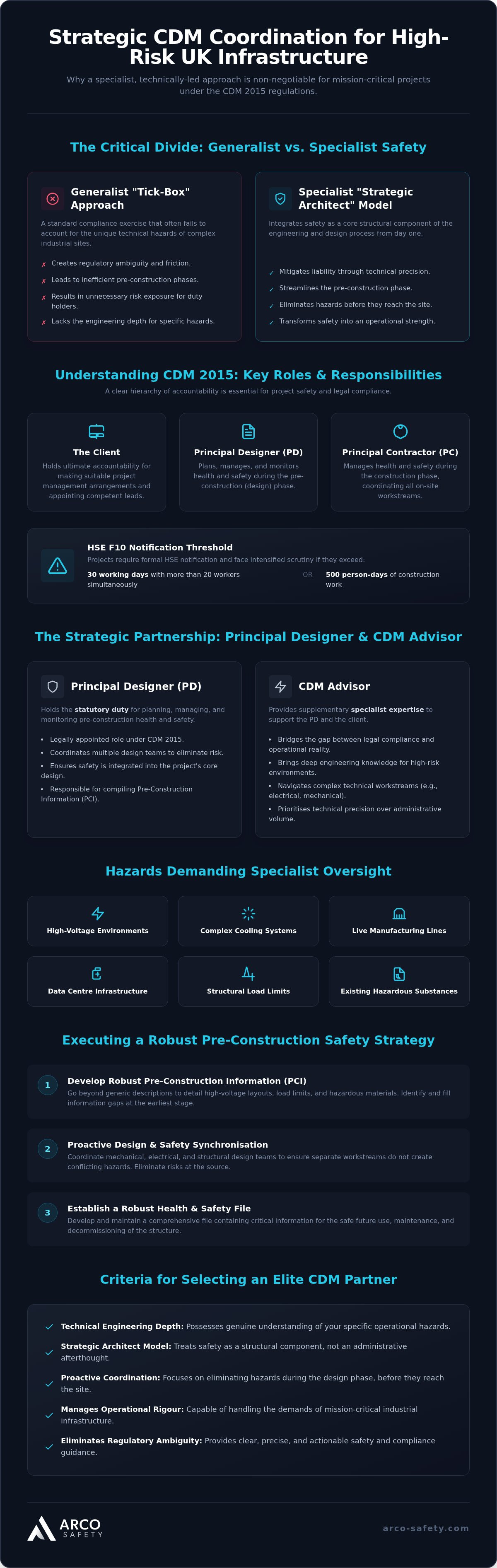
The regulations establish a clear hierarchy of responsibility. The Client holds the ultimate accountability for making suitable arrangements for project management. They must appoint a Principal Designer to oversee the pre-construction phase and a Principal Contractor to manage the construction phase. As we move towards 2026, the Health and Safety Executive (HSE) continues to emphasise early intervention and the proportionality of duties. This means the level of oversight must match the inherent danger of the workstream. On high-risk sites, the margin for error is non-existent, and the coordination must be equally uncompromising.
The Necessity of Technical CDM Oversight
Standard construction safety often focuses on common site hazards like falls or manual handling. Industrial infrastructure requires a more rigorous approach. High-voltage environments, complex cooling systems, and live manufacturing lines introduce variables that standard safety protocols cannot address. CDM coordination is the proactive synchronisation of design and safety to eliminate hazards before they reach the site. We adopt a "Strategic Architect" model where safety isn't an afterthought but a structural component of the engineering process. This level of precision is essential when a single oversight could lead to catastrophic failure or total operational shutdown.
Legal Liability and the Duty Holder Framework
Non-compliance carries severe consequences. Beyond the immediate threat to life, corporate and personal liability can result in unlimited fines or custodial sentences. The Client's duty to appoint competent leads is non-negotiable. For projects meeting the F10 notification threshold, which includes any project exceeding 30 working days with more than 20 simultaneous workers or 500 person-days, the HSE's scrutiny intensifies. Strategic coordination mitigates these risks by ensuring a robust Health and Safety File is developed and maintained. This document provides the critical information required for the safe future use and maintenance of the structure, protecting the asset's value and the duty holder's reputation for decades.
The Strategic Role of the Principal Designer and CDM Advisor
The Principal Designer (PD) is the strategic linchpin of pre-construction safety. They are responsible for planning, managing, and monitoring health and safety during the design phase. This involves more than just identifying risks; it requires the active coordination of multiple design teams to ensure that safety is baked into the project's DNA. In complex infrastructure, where mechanical, electrical, and structural designs intersect, the PD must ensure that these separate workstreams don't create conflicting hazards. This is why choosing elite CDM coordination services UK is a critical decision for any project director.
Many organisations find that a statutory PD lacks the specific engineering expertise required for high-risk infrastructure. This is where a CDM Advisor becomes essential. While the PD holds the legal duty, the Advisor provides the technical gravity needed to navigate complex workstreams. Engaging specialist CDM coordination services UK allows duty holders to bridge the gap between legal compliance and operational reality. It's a partnership that prioritises technical precision over administrative volume.
Managing the Pre-Construction Information (PCI)
A robust PCI is the foundation of site safety. For industrial projects, this document must go beyond generic site descriptions. It needs to detail high-voltage layouts, structural load limits, and existing hazardous substances. We focus on identifying information gaps during the earliest stages. If the PCI is incomplete, the Principal Contractor cannot plan work safely, leading to avoidable delays and increased liability. The resulting Health and Safety File should be treated as a living asset. It's not a dusty binder for the shelf; it's a precise manual for future maintenance and decommissioning.
Design Risk Management Workshops
Design Risk Management (DRM) workshops are where technical leadership is most visible. These are not standard progress meetings. They are rigorous technical sessions where we challenge unsafe design assumptions. For engineering-heavy projects, we facilitate intensive discussions between structural, electrical, and mechanical designers. The goal is to integrate "Safety by Design" principles into every build programme. By addressing risks like working at height or confined space access during the design phase, we eliminate hazards before they reach the construction site. This proactive approach is a core component of our CDM Management framework, ensuring that technical precision drives safety outcomes. This methodical coordination ensures that every designer understands their contribution to the collective safety of the project.
Specialist Oversight: Data Centres and High-Voltage Environments
Mission-critical infrastructure demands a departure from standard construction safety protocols. Data centres and high-voltage (HV) environments are not typical building sites. They are high-density engineering environments where the margin for error is non-existent. In these sectors, CDM coordination services UK must move beyond administrative support to provide genuine technical leadership. Failure to account for the specific hazards of energised systems or complex mechanical and electrical (M&E) layouts can lead to catastrophic operational failure or life-altering incidents.
The transition from shell and core to the fit-out phase in industrial projects represents a significant spike in risk. During this period, multiple contractors operate in confined spaces, often installing sensitive equipment whilst adjacent systems are being commissioned. Managing this intersection requires a level of coordination that generalist consultants cannot provide. It involves a deep understanding of the equipment being installed and the rigorous standards required to maintain operational continuity.
CDM Management for Data Centre Build Cycles
Data centre construction is defined by its intensity. The sheer density of M&E services creates unique challenges for design coordination and physical installation. We focus on the "Strategic Architect" model to manage these workstreams. This ensures that cable management, cooling infrastructure, and power distribution systems are designed with safe access for future maintenance in mind. Coordination during the fit-out phase is particularly vital. We ensure that the Principal Contractor's phase plan accounts for the high-pressure environment of a live data centre, protecting the integrity of the build and the safety of the specialist technicians involved.
High-Voltage and Industrial Electrical Safety
Working with high-voltage systems requires a specialised layer of oversight that sits within the CDM framework. Our approach integrates electrical safety specialists directly into the Principal Designer team. This allows us to manage the risks of energised systems during the construction and commissioning phases. Generalist health and safety consultants often fail in HV environments because they lack the technical depth to challenge electrical design assumptions or verify the competency of specialist contractors. We bridge this gap by providing authoritative Electrical Safety Oversight that aligns with the Electricity at Work Regulations 1989 and CDM 2015.
In manufacturing and automotive workstreams, the installation of new plant machinery often brings the intersection of CDM and PUWER (Provision and Use of Work Equipment Regulations 1998) into sharp focus. Coordination must extend to the equipment manufacturers to ensure that the machinery is safe to install, use, and maintain. By embedding technical precision into the CDM process, we ensure that new industrial assets are integrated into the facility without compromising the safety of the existing workforce or the stability of the production line.
Executing a Robust Pre-Construction Safety Strategy
Successful infrastructure projects are won or lost in the pre-construction phase. This is the period where strategic decisions dictate the safety profile of the entire build. Effective CDM coordination services UK provide the framework for this execution, moving beyond administrative compliance to establish a rigorous sequence of safety milestones. When managed with technical gravity, this phase eliminates the regulatory ambiguity that often plagues complex industrial workstreams.
The execution of a robust strategy follows a deliberate, five-step sequence. It begins with the early appointment of the Principal Designer to ensure safety influences the design from inception. This is followed by exhaustive competency assessments of all project appointees. We then develop a bespoke Pre-Construction Information (PCI) pack that provides contractors with the technical data required for safe bidding and planning. The process concludes with a seamless transition to the Construction Phase Plan (CPP) and the accurate management of the F10 notification. For projects exceeding 30 working days with more than 20 simultaneous workers, or those surpassing 500 person-days, this notification is a critical legal trigger for HSE oversight.
Competency Assessments for Elite Workstreams
Standard safety questionnaires are insufficient for high-risk industrial environments. We replace generic tick-box exercises with deep technical capability reviews. This involves evaluating the organisational capability of contractors to manage specific risks such as high-voltage installations or complex structural builds. A specialist CDM coordinator acts as a technical gatekeeper, vetting engineering firms not just on their past performance, but on their current ability to deploy safe systems of work in demanding environments. This rigour ensures that every entity on site possesses the specific expertise required for the task at hand.
The Construction Phase Plan (CPP) Review
A "suitable and sufficient" CPP is more than a collection of generic risk assessments. For industrial sites, it must be a live document that addresses high-risk activities with surgical precision. We monitor the development of the CPP to ensure it covers critical areas like Working at Height Safety and the management of live services. The plan must be active and adaptable, reflecting the actual risks present on site as the build progresses. Our role is to ensure that the Principal Contractor's strategy is grounded in operational reality rather than abstract theory, providing a stable foundation for the construction phase to begin without delay.
Selecting an Elite CDM Partner for Complex Workstreams
Selecting a partner for CDM coordination services UK is a strategic decision that defines the safety trajectory of your project. In mission-critical environments, the sheer volume of administrative paperwork is secondary to the technical precision of the oversight provided. High-risk infrastructure requires more than a consultant who monitors compliance from the periphery. You need an embedded partner that operates with the same level of engineering rigor as your design and construction teams. This approach ensures that safety is treated as a structural component of the project rather than a secondary administrative burden.
A specialist partner bridges the gap between statutory duty and operational reality. By understanding the specific hazards of industrial, automotive, and electrical workstreams, an elite coordinator identifies risks that generalists frequently overlook. This deep technical integration allows for the seamless management of complex workstreams, ensuring that regulatory compliance supports, rather than hinders, your project's momentum. It's about moving beyond the "safety generalist" model to embrace a persona of elite technical leadership.
Technical Leadership vs. Generalist Advice
High-stakes projects cannot afford the limitations of generalist advice. A generalist often focuses on broad health and safety principles that lack the depth required for a data centre build or a high-voltage installation. In contrast, an "Elite Technical Leader" possesses the earned confidence to challenge unsafe design assumptions and enforce rigor in demanding environments. Arco Safety’s commitment to excellence is grounded in this technical gravity. We don't just advise on regulations; we provide the strategic architecture necessary to manage intricate industrial risks. This level of uncompromising oversight is essential for protecting both the workforce and the commercial interests of the duty holder.
Securing the Future of Your Project
The value of strategic CDM leadership extends well into the operational life of the asset. A high-quality Health and Safety File is a critical document that reduces long-term operational risk. It serves as a precise manual for future maintenance, ensuring that those who manage the building in the coming decades have the information they need to work safely. By prioritising technical precision during the pre-construction and construction phases, you secure the future value of your infrastructure. Engage Arco Safety Ltd for strategic CDM Management and technical oversight to ensure your project is managed with the professional depth and operational rigor it requires.
Securing the Strategic Architecture of Your Project
Managing high-risk infrastructure requires a departure from standard safety models. We've explored how technical leadership in data centre and high-voltage environments prevents catastrophic failure and operational downtime. Elite CDM coordination services UK provide the strategic architecture necessary to navigate these complexities; ensuring that safety is a structural component of your build rather than a secondary administrative task. By appointing a Principal Designer early and prioritising technical precision over administrative volume, duty holders can effectively mitigate long-term liability.
Arco Safety Ltd bridges the gap between regulatory duty and operational reality. Our specialist focus on mission-critical infrastructure, combined with deep expertise in high-voltage and industrial electrical safety, ensures your project is managed with uncompromising rigor. Whether you're overseeing data centre construction or automotive workstreams, our technical oversight provides the security your project demands. Partner with Arco Safety Ltd for elite CDM coordination and technical safety leadership to ensure your next project achieves total operational excellence. We look forward to supporting your vision with the precision it deserves.
Frequently Asked Questions
What are the legal consequences of failing to appoint a CDM Principal Designer?
The Client becomes legally responsible for all Principal Designer duties if they fail to make a formal appointment. This significantly increases the Client's personal and corporate liability for any health and safety failings during the pre-construction phase. Failure to appoint can lead to HSE enforcement action, including unlimited fines or prosecution if a project meeting the notification threshold proceeds without these essential duty holders in place.
How does CDM coordination differ for data centre projects compared to standard builds?
Data centre projects require managing high-density mechanical and electrical services within a condensed and technically complex footprint. Standard builds rarely face the same level of risk regarding cooling infrastructure and power distribution. Specialist CDM coordination services UK are essential in these environments to manage the intense fit-out phases and ensure that future maintenance access is designed into the facility's architecture from the earliest stages.
Can one organisation hold multiple roles under CDM 2015?
An organisation can hold multiple roles, such as Client and Principal Designer, provided they possess the necessary skills, knowledge, and experience. They must also ensure they have the organisational capability to manage the distinct duties of each role effectively. In high-risk infrastructure, separating these roles often provides a more robust system of technical checks and balances, ensuring that safety oversight remains independent and rigorous.
What specific information must be included in the Pre-Construction Information (PCI)?
The PCI must include technical data regarding existing hazards, such as high-voltage cable routes, structural load capacities, and any hazardous materials present on site. It provides the foundation for the Principal Contractor's safety planning. For industrial sites, this document needs to be exhaustive. It must detail site-specific risks that could impact the construction phase, such as proximity to live manufacturing lines or energised systems.
How is the F10 notification managed for multi-phase industrial projects?
The F10 notification must be updated or resubmitted if the project scope or duration changes significantly across different phases. The Client is responsible for notifying the HSE once the project meets the notification thresholds: lasting longer than 30 working days with over 20 simultaneous workers, or exceeding 500 person-days. Accurate management ensures that the HSE is informed of the specific risks present during each distinct phase of the build.
What is the role of the CDM coordinator in managing electrical safety risks?
The coordinator integrates electrical safety specialists into the design process to identify hazards associated with energised systems. They ensure that "Safety by Design" principles address the risks of high-voltage installations before work begins on site. This involves reviewing the competency of specialist contractors and verifying that the Construction Phase Plan includes specific protocols for working near live electrical infrastructure to prevent accidental contact or flashover.
How does Arco Safety Ltd support high-risk infrastructure projects nationally?
Arco Safety Ltd provides elite technical leadership across the UK, specialising in data centres, high-voltage environments, and industrial manufacturing. We act as a strategic partner, delivering precise CDM Management and Electrical Safety Oversight to protect duty holders and workforces. Our approach focuses on operational rigor and technical precision, ensuring that complex infrastructure projects meet the highest safety standards from inception through to final delivery.
When should a CDM Advisor be appointed in the project lifecycle?
A CDM Advisor should be appointed as early as possible, ideally during the feasibility or initial design stages. Early involvement allows the advisor to influence the design architecture and identify risks before they become embedded in the project. This proactive appointment ensures that CDM coordination services UK are integrated into the pre-construction phase, streamlining the transition to the construction site and reducing the likelihood of costly design changes.
